
No. Beem does not require employment verification. There is no employer phone call, no HR department contact, no pay stub upload, no W-2 submission, and no letter of employment needed at any point during sign-up or while using the app.
This is one of the most common questions people ask before downloading Beem, and the concern makes sense.
Traditional lenders, many credit products, and even some cash advance apps require proof of employment through employer verification, payroll system connections, or documentation that confirms where you work, what you earn, and how long you have been there.
If you have been rejected by one of those products because your employment does not fit a traditional mold, you are right to ask whether Beem will do the same thing.
It will not. Here is how Beem actually verifies your income and why employment verification is not part of the process.
How Beem Verifies Income Instead
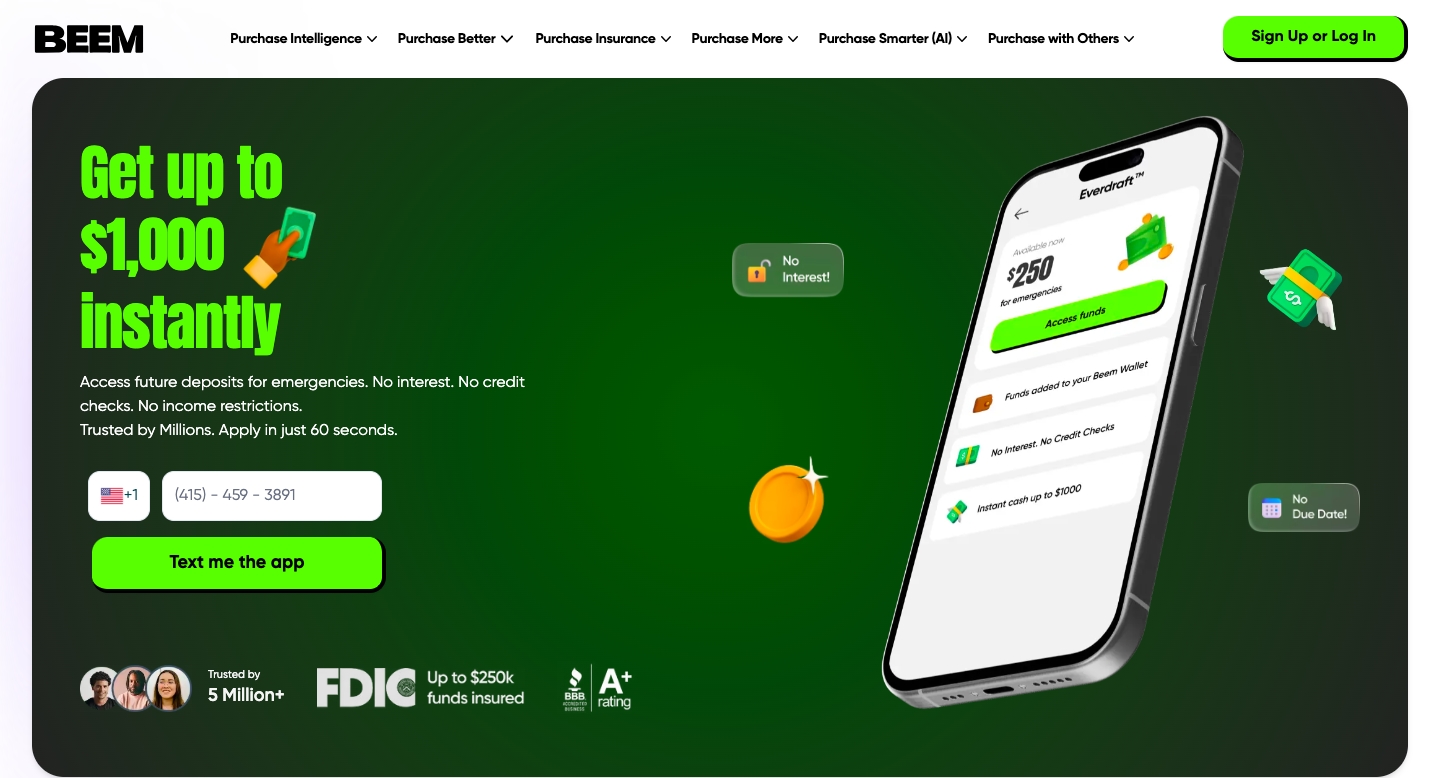
Beem uses bank account verification rather than employment verification. When you link your bank account to Beem, the system analyzes your transaction history to understand your financial picture. It looks at what comes into your account, how often, how consistently, and in what amounts.
This approach verifies that you have income. It does not verify where that income comes from, who your employer is, or what your job title is. The distinction matters enormously for the millions of Americans whose income does not come from a single traditional employer.
What the System Looks At
Deposit frequency. How often do deposits arrive in your account? Weekly? Biweekly? Daily? Irregular? The system reads the pattern to assess income predictability.
Deposit amounts. How much is coming in per deposit and per month? The amounts help determine what Everdraft™ cash advance limit your income can support. A higher, more consistent income generally supports a higher advance limit.
Deposit sources. The system can identify whether deposits are direct deposits from a payroll system, ACH transfers from gig platforms, government benefit payments, peer-to-peer transfers, or other sources. All of these count as income for verification purposes. None of them require employer contact.
Account balance patterns. How does your balance behave throughout the pay cycle? Consistent positive balances signal healthy cash flow. Frequent drops to zero or negative territory indicate tighter margins. This data helps Beem assess how much you can comfortably borrow and repay.
Transaction history length. A bank account with several months of history gives the system more data to work with than a brand-new account. Longer history generally translates to more accurate assessments and potentially higher Everdraft™ limits.
What the System Does NOT Look At
Your employer's name or contact information
Your job title, role, or employment status
Whether you work full-time, part-time, or not at all
Your employment history or tenure at a specific company
Tax documents (W-2s, 1099s, tax returns)
Pay stubs or salary letters
Beem does not ask for any of this information because it does not need it. Your bank activity tells the system everything it needs to know about your ability to receive and repay an advance.
Who Qualifies Without Employment Verification
Because Beem verifies income through bank activity rather than employer contact, a wide range of income sources qualify. You do not need a 9-to-5. You do not need a single employer. You do not need to be employed at all in the traditional sense, as long as you have verifiable income hitting your bank account.
Traditional Employees (Full-Time and Part-Time)
If you work for an employer and receive direct deposit paychecks, Beem's system recognizes those deposits automatically. Full-time and part-time workers with consistent paychecks typically qualify quickly and often receive higher Everdraft™ limits because their deposit patterns are predictable.
Part-time workers are not penalized for earning less than full-time workers. The system evaluates your income relative to the advance you are requesting, not against an arbitrary income threshold. A part-time retail worker earning $800 biweekly qualifies for advances proportional to that income. There is no minimum salary requirement.
Gig Workers and Delivery Drivers
DoorDash, Uber, Lyft, Instacart, Grubhub, Amazon Flex, TaskRabbit, and other gig platforms pay workers as independent contractors. There is no employer to verify because you are not technically employed by these companies. You are an independent contractor receiving payments for completed work.
Beem's bank-based verification handles this seamlessly. Weekly gig deposits, DasherDirect transfers, daily Uber payouts, and Instacart batch payments all appear as income in your bank account. The system reads these deposits the same way it reads a W-2 paycheck: money coming in on a recurring basis.
Gig workers with multiple platforms (DoorDash plus Uber Eats plus Instacart, for example) benefit from the aggregated income view. Beem sees all deposits across all sources in your linked bank account, not just one. Your combined gig income is what determines your Everdraft™ eligibility, even though no single "employer" could verify it.
Freelancers and Self-Employed Individuals
Freelance designers, writers, consultants, photographers, contractors, and other self-employed professionals face the same verification wall that gig workers do: no employer exists to call. Beem does not require one.
Client payments via ACH, direct deposit, wire transfer, or platform payouts (Upwork, Fiverr, Toptal, etc.) all register as income in your bank account. The main factor the system evaluates for freelancers is consistency. Freelancers with regular client payments every week or two typically qualify more easily than those with large but sporadic deposits every few months. If your income is irregular, building a history of deposits over several weeks before requesting your first advance helps the system assess your profile more accurately.
Government Benefit Recipients
Social Security, SSI (Supplemental Security Income), SSDI (Social Security Disability Insurance), VA benefits, unemployment insurance, pension payments, and other government benefits deposited into your bank account qualify as income for Beem's verification process.
These deposits are often the most predictable income source the system encounters: same amount, same date, every month. Government benefit recipients frequently qualify for Everdraft™ access without any issues because the deposit pattern is exceptionally consistent.
No employment verification is possible for retirees or disability recipients because they are not employed. Beem's bank-based model makes this irrelevant. The income exists. The system sees it. That is what matters.
Students With Part-Time Income or Stipends
College students working part-time jobs, receiving stipends, work-study payments, or regular transfers from family members may qualify based on the deposits appearing in their linked bank account. The key is consistency: regular deposits of any size establish a pattern the system can evaluate.
Students with brand-new bank accounts and minimal history may need a few weeks of deposit activity before the system has enough data to determine Everdraft™ eligibility. Opening the account, routing income to it, and allowing a pattern to develop is the best approach.
People With Multiple Income Sources
Many Americans piece together income from several sources: a part-time job, a weekend gig, a small freelance client, and a monthly benefit payment. Traditional employment verification can only confirm one of those sources and misses the rest. Beem's bank-based approach sees every dollar that enters your account, regardless of where it comes from. Your combined income, not any single source, is what the system evaluates.
This makes Beem particularly accessible for people whose financial reality does not fit into a single "employer" box.
Why Traditional Employment Verification Fails So Many People
Beem's decision to skip employment verification is not a shortcut. It is a design choice that reflects how people actually earn money in 2026.
The gig economy has reshaped income. According to a 2024 McKinsey study, 36% of employed Americans identify as independent workers. That is roughly 58 million people whose income comes from gig platforms, freelance contracts, or self-employment. Employment verification excludes every one of them.
Multiple job holders are increasingly common. The Bureau of Labor Statistics reports that over 8 million Americans hold two or more jobs simultaneously. An employment verification call to Employer A does not capture income from Employer B, C, or a weekend gig. The total picture is invisible to traditional verification methods but fully visible in bank account data.
Government benefit recipients have no employer. Over 70 million Americans receive Social Security benefits. Millions more receive SSI, SSDI, VA benefits, or state-level assistance. Employment verification is structurally impossible for these individuals, yet their income is real, consistent, and verifiable through bank deposits.
Employer verification is slow and unreliable. Even when employment can be verified, the process is slow. Payroll departments do not answer calls on weekends. Verification services take days. Small businesses may not have a formal HR process at all. Bank-based verification delivers results in minutes because the data is already there.
How to Set Up Your Account for the Smoothest Verification
While Beem does not require employment verification, there are steps you can take to ensure your bank-based verification goes as smoothly as possible and your Everdraft™ limit starts at the highest level your income supports.
Link your primary bank account. Connect the account where most of your income is deposited. If you receive income across multiple bank accounts, link the one with the most consistent and highest-volume deposits.
Use direct deposit when available. If your employer, gig platform, or benefit provider offers direct deposit, set it up to route to your linked bank account. Direct deposits are the clearest signal to the system and typically result in higher initial Everdraft™ limits compared to manual transfers or check deposits.
Allow a deposit history to develop. If your bank account is brand new, give it two to four weeks of deposit activity before expecting your full Everdraft™ limit. The system needs enough data points to assess your income pattern. A few consistent deposits establish the foundation.
Keep your bank connection active. If your bank credentials change (new password, updated security questions), update them in the Beem app immediately. A broken bank connection interrupts the system's ability to read your deposit activity and can delay verification or limit adjustments.
Avoid frequent bank account switches. Consistently using the same linked bank account builds a deeper transaction history, which supports higher advance limits over time. Switching bank accounts frequently resets the history the system relies on.
FAQ: Beem Employment Verification
Does Beem call your employer?
No. Beem does not call, email, fax, or contact your employer in any way. There is no employer verification step in the sign-up process or at any point while using the app. Income is verified entirely through your linked bank account's transaction history.
Does Beem require pay stubs or tax documents?
No. Beem does not require pay stubs, W-2s, 1099s, tax returns, or any employment documentation. The system verifies income by analyzing deposits in your linked bank account. No documents need to be uploaded or submitted.
Can I use Beem if I am self-employed?
Yes. Self-employed individuals, freelancers, and independent contractors qualify for Beem and Everdraft™ advances based on the income deposits visible in their linked bank account. Client payments, platform payouts, and business income all count. No business license, tax ID, or employer verification is needed.
Can I use Beem if I receive government benefits?
Yes. Social Security, SSI, SSDI, VA benefits, unemployment insurance, pension payments, and other government deposits qualify as income for Beem's verification process. These deposits are often among the most consistent patterns the system encounters, which typically results in smooth qualification and stable Everdraft™ limits.
Does Beem have a minimum income requirement?
Beem does not publish a fixed minimum income threshold. Everdraft™ eligibility and advance limits are determined by the overall pattern of deposits in your linked bank account, including frequency, consistency, and amount. Lower income levels are not automatically disqualified. The system evaluates your income relative to the advance amount you are requesting.
Can I use Beem if I work part-time?
Yes. Part-time workers qualify based on the deposits appearing in their bank account, just like full-time workers. Your Everdraft™ limit will reflect your income level, meaning a part-time worker may receive a lower advance limit than a full-time worker, but part-time status itself does not disqualify you.
What if my income is irregular?
Irregular income (common among freelancers, gig workers, and seasonal workers) does not disqualify you from using Beem. However, the system may take longer to assess your income pattern and may initially offer a lower Everdraft™ limit until it builds confidence in your deposit history. The most effective approach is to allow several weeks of deposit activity before expecting your full limit and to repay every advance on time to build your profile.
Disclaimer: The information provided in this article is for general guidance purposes only and does not constitute financial, legal, or employment advice. Everdraft™ eligibility, advance limits, and verification processes are determined by Beem based on individual account activity, deposit history, and other factors. Actual advance amounts and eligibility may vary. Beem reserves the right to modify its verification and eligibility criteria at any time. For the most current policies, refer to Beem's Terms of Service and Privacy Policy at trybeem.com. Beem is not a bank. Banking services are provided by FDIC-insured partner institutions.
Was this article helpful?
That’s Great!
Thank you for your feedback
Sorry! We couldn't be helpful
Thank you for your feedback
Feedback sent
We appreciate your effort and will try to fix the article